.png)
From Operational Complexity to Operational Clarity
Understanding what really drives production
Most factories are data rich — but operationally blind.
Understanding what really drives production
Most factories are data rich — but operationally blind.
Every machine, every shift, every system produces data — but it lives in silos. No one has a complete operational picture. Decisions get made on intuition, tribal knowledge, and yesterday's reports.
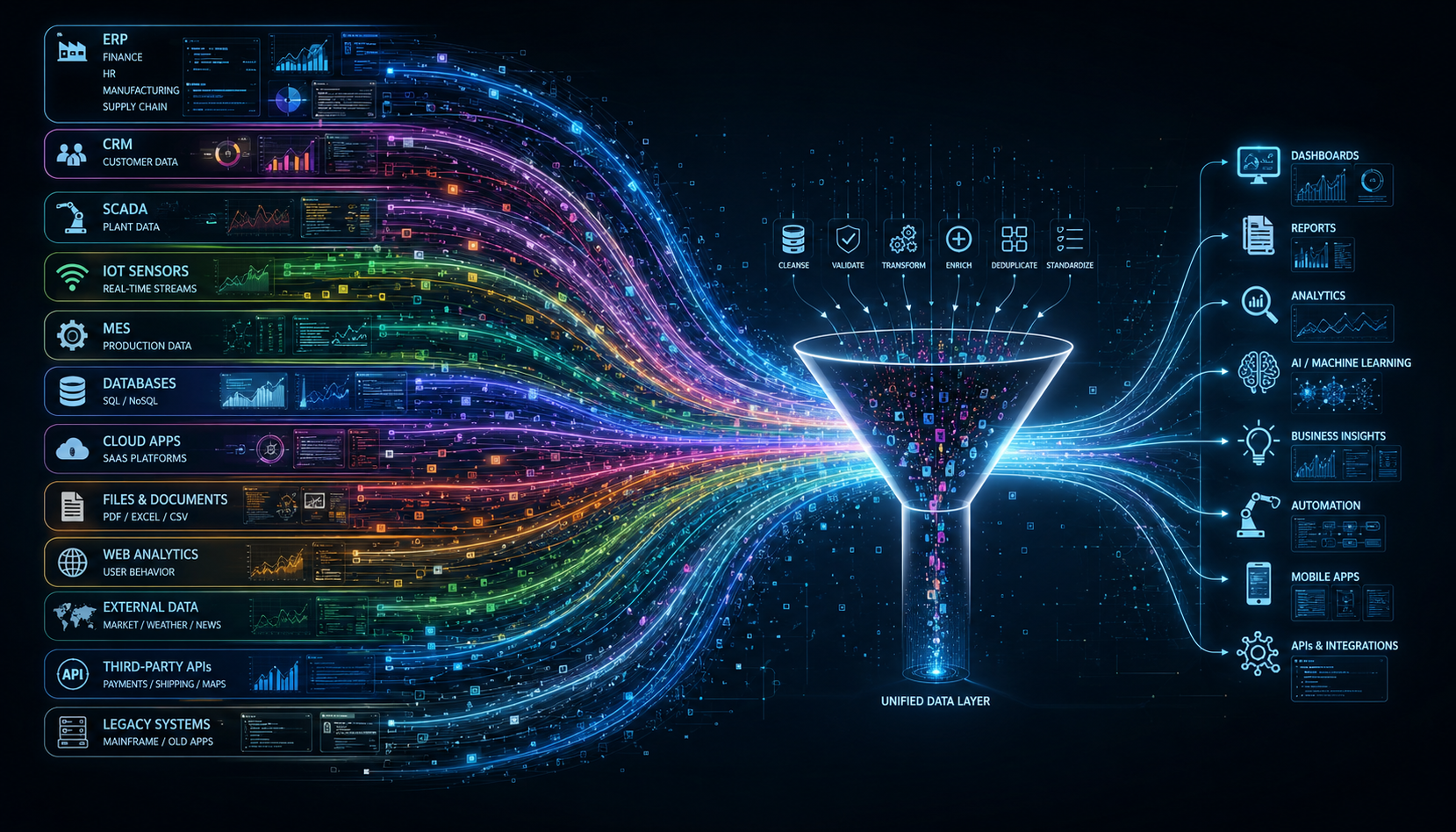
Your factory generates data from every direction. The problem is connecting it into operational understanding.
Select all that apply and add the system name if you have one.
Four patterns we see consistently across industrial operations.
Production plans are built on assumptions. The moment a machine stops, an order changes, or a material is delayed — the plan breaks. Replanning is manual, slow, and based on incomplete data.
Short stops and micro-inefficiencies never make it into the OEE report. They happen, disappear, and accumulate silently — eating capacity that management doesn't know is being lost.
Critical operational decisions depend on specific people who know "how things really work." When they're unavailable, production slows. When they leave, the knowledge goes with them.
Production, QA, maintenance, and planning each see a different slice of reality. Decisions get made in isolation — optimized locally, suboptimal for the whole operation.
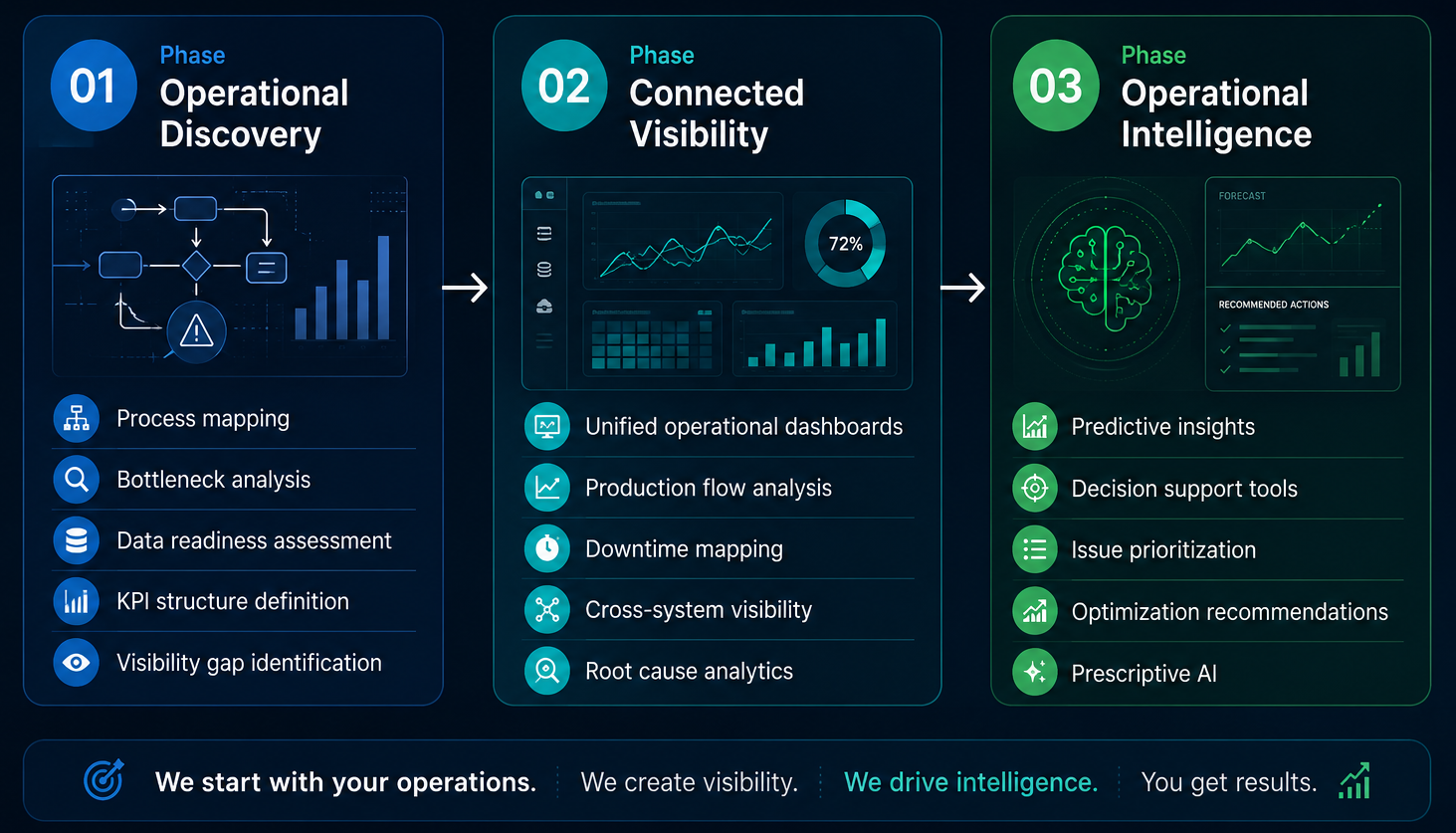
Before AI can help, operations need a solid foundation. Most factories skip this step — and pay for it.
Data exists in silos — machines, ERP, operators. Unstructured, uncleaned, unconnected.
Systems begin to talk to each other. A unified data layer starts to form.
For the first time, you can see what's actually happening across the operation — in real time.
Patterns emerge. You understand why problems happen, not just that they happened.
The operation anticipates problems before they occur. Decisions shift from reactive to proactive.
The system recommends specific actions. Operations run with minimal intervention.
The first step is not AI. The first step is operational clarity — understanding how your operation truly behaves before trying to automate or predict it.
Starting from your real operational problems — not from technology.
Over time, Mindora becomes embedded in how your operation thinks and decides.
Understands factory behavior — patterns, rhythms, anomalies — across every department.
Detects problems early, before they cascade into production disruptions.
Prioritizes the issues that matter most — ranked by operational and financial impact.
Recommends specific actions and continuously improves as it learns from outcomes.
We bridge the gap between factory operations and intelligent decision-making. Not AI consultants who visited a factory once.


Which parts of the operation run on intuition or tribal knowledge with no data backing?
Where does the shift supervisor or production manager act on gut feel rather than data?
Which systems hold valuable data that never reaches the people who need it most?
Where is operational chaos costing you capacity you don't even know you're losing?
Which recurring operational problem has never been fully solved — and why?
In 12 months, what would need to be true for this to have been worth it?
Which manual, repetitive tasks eat up hours every week that could be automated or streamlined?